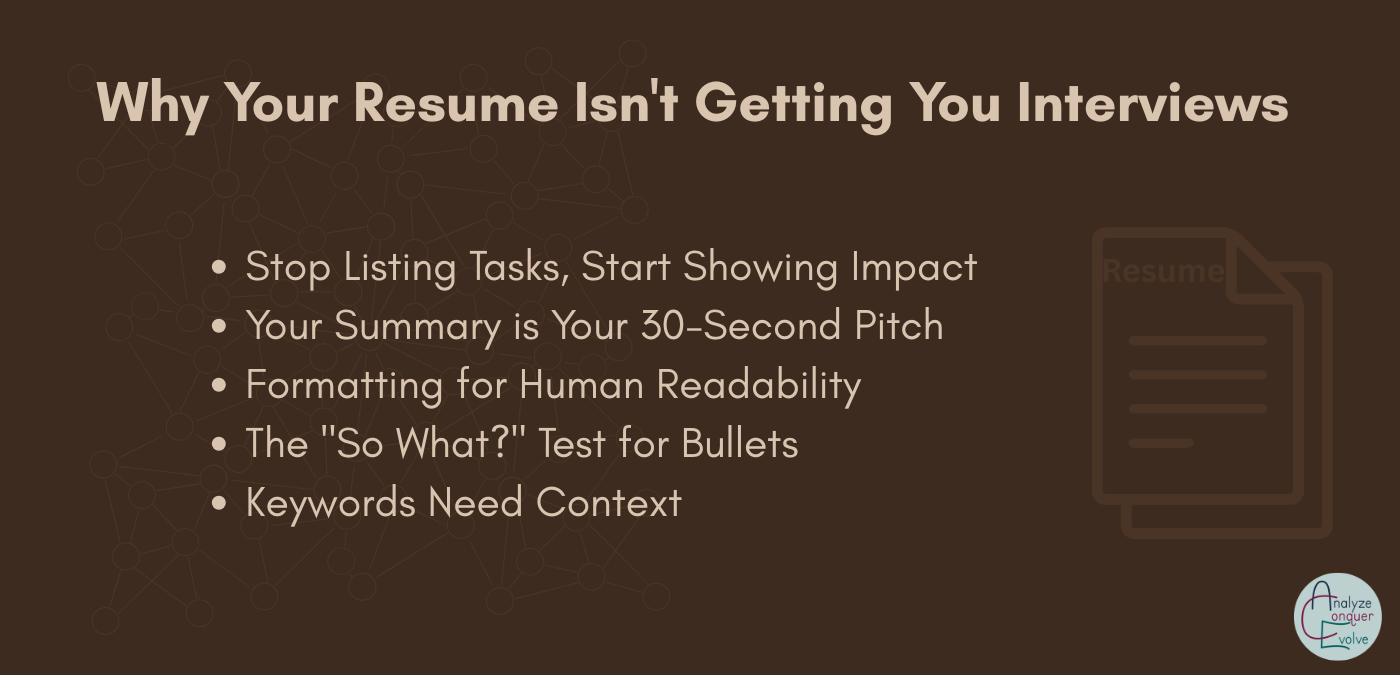
You have submitted dozens of applications. You tailored your resume, adjusted the formatting, and integrated keywords from the job description. Yet your inbox remains quiet.
It is exhausting, and it is far more common than most candidates realize.
The core bottleneck is rarely your technical competence or even your page layout. The real issue is that your resume fails to communicate a sharp, compelling narrative regarding who you are and what tangible value you create. Hiring managers and technical recruiters do not spend five minutes reading each submission; eye-tracking research consistently reveals they spend between 6 and 30 seconds on an initial scan. If your document does not immediately answer the right questions, it gets set aside.
The Fundamental Flaw: Resumes That Read Like Job Descriptions
Most technical resumes read like copied HR job requisitions: "Managed a team of five engineers," "Responsible for weekly data reporting," "Supported cross-functional system integrations."
That phrasing reveals what you were assigned to do. It fails to demonstrate what you actually delivered, how you engineered the solution, or why your execution was superior.
Mistake 1: Listing Routine Tasks Instead of Measurable Outcomes
This is the single most frequent mistake in technical resumes. Candidates describe passive duties rather than quantifiable business impact.
✅ After (Measurable Outcome): Streamlined the monthly reporting cadence for a 12-person regional sales team, reducing delivery turnaround from five days to two and eliminating manual entry errors via automated SQL pipelines.
Both statements describe the identical role, but the second proves engineering discipline and measurable business impact. You do not need company-saving metrics on every line; operational efficiencies, saved analyst hours, automated manual workflows, and positive stakeholder reviews all constitute verified wins.
To identify your hidden achievements, ask yourself:
- What systems would have slowed down or broken if I had not been in this seat?
- What manual process did I automate, refactor, or document?
- What feedback did stakeholders or engineering directors share during my performance reviews?
Mistake 2: An Unfocused, Generic Professional Summary
Many candidates either omit the summary entirely or open with generic clichés: "Results-driven technical professional with over 10 years of experience seeking a challenging opportunity." That language tells the reader nothing useful.
Your summary should answer a single question: Why should the reviewer keep reading?
The 3 Requirements of an Impactful Summary
- Professional Identity: Your exact specialization, seniority level, and primary domain depth.
- Core Competency: The specific business or technical problems you excel at solving.
- Target Focus: The operational environment and technical challenges where you deliver maximum leverage.
Mistake 3: Keyword Stuffing Without Operational Context
Applicant Tracking Systems (ATS) index resumes for target keywords, but stuffing twenty tools into an isolated skills block without context backfires the moment a human manager evaluates your profile.
Listing "SQL, Python, Snowflake, Tableau" proves familiarity, but it does not convey depth. Weave those technologies directly into your project achievements so reviewers see how you deployed the stack under production conditions.
Write: Architected modular dbt transformation models on Snowflake to standardize core revenue metrics, powering executive Tableau dashboards that tracked 45M in annual recurring revenue.
Mistake 4: Focusing on the Past Rather Than the Target Role
Your resume should be written for the position you want next, not merely an archival log of every task you have completed since graduation.
If you are an analyst pivoting toward analytics engineering, your resume should highlight data modeling, version control, and pipeline automation rather than one-off presentation slide formatting. Reorder your bullet points and adjust your technical emphasis to match the requirements of your target requisition.
Mistake 5: Visual Formatting and Length Getting in the Way
Over-designed templates with multi-column graphics, progress bars, and custom icons confuse ATS parsers and frustrate hiring managers. Prioritize clean readability:
- Save as a Standard PDF: PDF preserves your fonts and layout across all devices. Word documents often break alignment or introduce parsing errors.
- Maintain an 11pt Minimum Body Font: Shrinking text to 9.5pt to squeeze content onto a single page harms legibility. If space is tight, edit for conciseness rather than reducing font size.
- Guidelines on Document Length: Aim for one page if you have under five years of experience, and two pages if you have five or more years of relevant technical history. A two-page document is completely standard; the rule is simply to ensure every line earns its space.
- Prune Distant History: Summarize or remove roles older than 10 to 12 years unless they directly demonstrate foundational technical skills required for the target seat.
What to Optimize First Today
If you have thirty minutes to upgrade your resume, begin with your experience bullet points. Review your two most recent positions and convert passive duty statements into outcome-driven achievements. Incorporate percentages, time savings, or scale where available.
Once your bullets are sharpened, refine your professional summary so it speaks directly to the business value you offer your target employer.
Align Your Resume and LinkedIn Profile
Your resume secures the initial screening call, but hiring managers almost universally cross-reference your LinkedIn profile before booking the technical panel. If your profile lacks detail, shows outdated dates, or contradicts your resume narrative, it introduces hesitation.
Ensure your LinkedIn profile reinforces the story on your resume while providing expanded technical context and portfolio links.