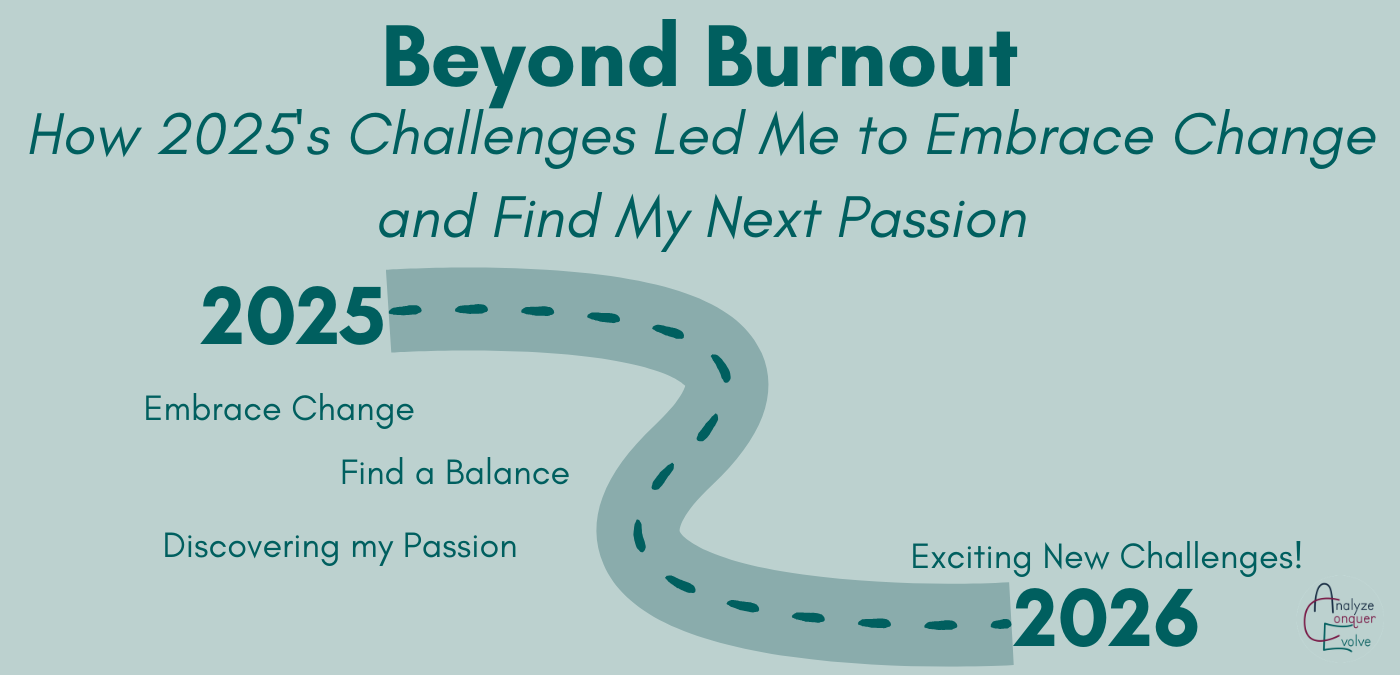
This past year has been a defining crucible for so many of us in the technology ecosystem, myself included. I could talk about the bruising reality of navigating the tech job market twice in a single year, or the painful personal loss of a family pet. Instead, I want to talk about the tactical personal growth that emerged from that volatility, and how navigating those constraints is defining my trajectory.
Navigating the Mechanics of Change
I have always categorized systemic change into two distinct buckets: exciting change and high-stress change. The exact same disruption can be perceived completely differently depending on your lens. Take how generative AI is shifting engineering workflows, for example. Some technical professionals view this automation as an exciting challenge to embrace, while others perceive it as a stressful threat to their domain expertise.
For me, this past year delivered a high concentration of rapid, stressful changes. Managing that level of professional and personal uncertainty forced me to build a practical framework for navigating volatility. If you are feeling stuck or overwhelmed by a toxic corporate environment, these three strategies can help restore your equilibrium:
- Slow Down to Take It All In: Instead of instantly reacting out of survival mode, force yourself to pause and analyze what is happening and why. This does not come naturally to high-output engineers. When you have spent your career processing variables instantly and executing solutions under pressure, forcing a deliberate pause reduces the panic of change, allowing you to move forward with a level, strategic head.
- Track and Analyze Your Progression: As someone who has operated within complex data pipelines for my entire career, I find immense peace in data collection and analysis. When everything feels chaotic, treat your situation like a dataset. Track your milestones, organize your daily actions, and use objective metrics to evaluate your progress rather than relying on emotional impressions.
- Celebrate All Wins (Small to Large): High achievers rarely celebrate their own achievements; standard operational state is to hit a target and immediately sprint to the next objective. Actively acknowledging minor breakthroughs keeps you grounded, reinforces your confidence, and makes navigating intense career changes manageable.
Deconstructing the Burnout Variable
Achieving true work-life balance is an ongoing optimization problem for high achievers. I am wired to run full-speed ahead, giving 1,000% effort to whatever system I am building. For the majority of my life, slowing down to prioritize rest felt like an efficiency loss.
Living at that velocity leaves you vulnerable to severe burnout. Industry volatility easily tips the scales. Restoring balance in a fast-paced environment is difficult, especially when working in a remote technical role where the lines between output and rest are blurred.
To fix this, I began implementing strict operational boundaries:
- True Disconnection: Establishing concrete backup coverage plans for ongoing workflows before logging off.
- Notification Silencing: Completely turning off corporate communication channels and work notifications during personal time.
- Actual PTO Utilization: Stopping the habit of treating vacation days as "remote work from a different room" and actually stepping away from the terminal.
By the final quarter of the year, I intentionally dialed back my operational speed even further, dedicating uninterrupted time to family and grounding myself outdoors. Closing out that cycle with zero burnout was an absolute victory.
Breaking Free From Career Auto-Pilot
As someone who enjoys diving into a wide array of technical and creative hobbies, the exhaustion of the corporate grind gradually diluted my core passion. I hit a point where I was truly questioning why I was pursuing the milestones I had set.
My passion for data, architecture, and team leadership had not died. Rather, it was a clear signal that it was time to step off the traditional path and build something that aligned with genuine execution joy.
It is easy to get stuck on a specific career ladder and operate entirely on auto-pilot. We set aggressive engineering or leadership goals and run full-steam ahead because it is what is expected of us. For years, my objective was a seat in the C-suite. When I realized that I wanted to pivot, I found myself paralyzed by the sheer number of options. I was stuck in severe analysis paralysis.
I ended that year with a bold new path, one that is not fully mapped out yet. And for the first time in my career, I am completely comfortable with that ambiguity.
Continuing the Evolution
I am stepping forward with an immense number of unknown variables. I am executing one of the largest career pivots of my life by launching my own practice to help other technical experts conquer these exact same bottlenecks.
Am I scared? A little bit. There are components of this new path that push and challenge my capabilities in new ways. But I am ready to embrace the volatility while keeping my operational boundaries firmly locked in place.