Eleven years into my career, I made the jump I had been working toward for a long time: a role that was 100% data focused, no more splitting time between generic IT support and the analytics projects I actually cared about.
On paper, it was everything I had been building toward. In reality, almost nothing was familiar. I was stepping into an entirely different industry. My entire career had been on-premises, but this role was 100% cloud native. I had spent over a decade in Microsoft shops; this company did not use a single Microsoft tool. They handed me a MacBook on day one. And the pace? I came from an organization that moved slowly and deliberately. This one moved fast. Really fast.
I had eleven years of experience and I felt like a complete beginner. I spent my first months waiting to be "found out."
Not found out for being unqualified, but found out for being exactly who I was: someone who had built real skills over a long career, now applying them in an unfamiliar environment, with unfamiliar tools, at an unfamiliar speed. As if the learning curve itself was proof I did not belong.
That feeling has a name. If you work in tech, especially if you have ever changed roles, industries, or tools mid-career, there is a very good chance you know it intimately.
What Imposter Syndrome Actually Is
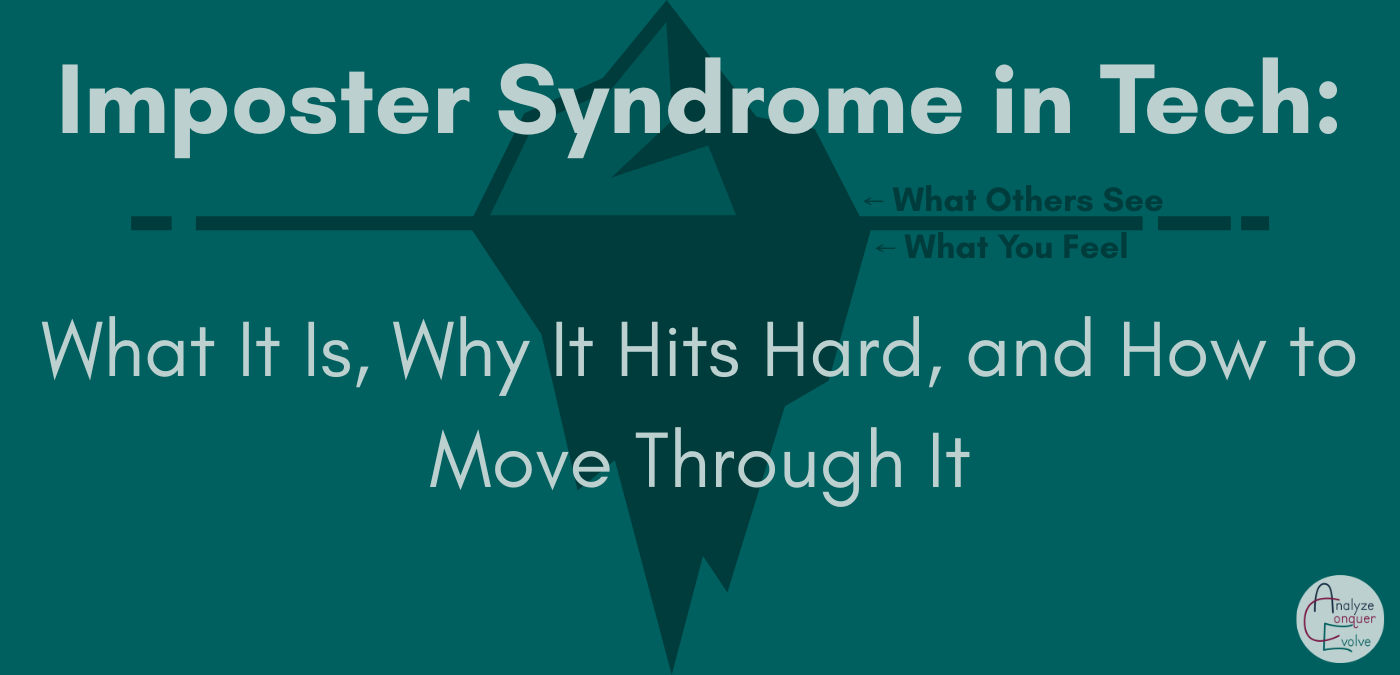
Imposter syndrome is the persistent internal experience of believing you are not as competent as others perceive you to be, coupled with the deep-seated fear that everyone will eventually figure that out.
First identified by psychologists Pauline Clance and Suzanne Imes in 1978, it was initially studied in high-achieving women. Since then, research has confirmed it shows up across genders, industries, and experience levels. Estimates suggest roughly 70% of professionals experience it at some point in their careers.
Here is what makes it particularly insidious: imposter syndrome tends to get louder as you advance. The more responsibility you take on, the more visible your role becomes, the sharper that internal voice gets. You might assume success would quiet it, but often, it does the exact opposite.
Why Tech Makes It Worse
Every industry has its self-doubt challenges, but technology has a unique way of amplifying them.
- The field changes faster than anyone can master: In data and engineering alone, the stack looks completely different than it did five years ago. New frameworks, languages, and tools arrive constantly. When peers sound fluent in the latest release, it is easy to interpret your own learning curve as evidence that you are falling behind. In reality, everyone is on a learning curve. The ones who look unflappable have simply learned to stay calm while figuring it out.
- There is always someone who knows more about a specific topic: Tech attracts deeply specialized minds. When you work alongside specialists, it is easy to compare your broad skill set against their single deepest specialty and conclude you come up short. What you rarely see is what they do not know, or the years of trial and error required to build that specific knowledge.
- Non-linear paths are the norm, not the exception: Very few practitioners in data and software followed a straight line. Career changers, self-taught developers, bootcamp alumni, and professionals who pivoted from music, biology, or teaching are the majority. When you did not follow a conventional path, it is easy to feel like you snuck in through a side door. You did not sneak in: you found a smarter route.
A Reframe That Changed How I Think About It
For most of my career, my strategy for dealing with imposter syndrome was straightforward: tell myself "I have got this" and push through. It worked, to a point. I showed up, delivered, and advanced.
However, I was treating it like an enemy to destroy rather than a signal worth inspecting.
Eventually, I started applying the 5 Whys framework to my own self-doubt. In engineering and data architecture, when an incident occurs, you ask "why" repeatedly until you uncover the root cause rather than patching the surface symptom. I turned that diagnostic inward. When self-doubt crept in, instead of white-knuckling past it, I paused and asked: why do I feel this way right now? And then asked again.
In Adam Grant's book Think Again, he examines whether we have misjudged imposter syndrome by framing it purely as a psychological defect to conquer. Reading that was validating. Getting curious about the feeling, rather than suppressing it, provided useful information.
Sometimes the root answer was that I genuinely had a technical skill gap to close. Other times, the answer was simply that I was attempting something new, and the discomfort was growth in disguise.
6 Practical Ways to Move Through It
1. Get Curious, Not Combative
When self-doubt flares up, resist the urge to immediately argue with it. Ask: what is this feeling specifically about? Is it an unfamiliar tool? Fear of public visibility? Comparing my progress to a peer? Naming the exact trigger removes its ambiguity and makes the next step clear.
2. Build a "Proof File"
Keep a running document of verified wins. Not just massive career promotions: track everything. Production outages you resolved, clean code reviews, complex schemas you modeled, and moments when cross-functional partners relied on your judgment. When imposter syndrome claims you do not belong, your proof file provides factual evidence to the contrary.
This document is also invaluable for annual reviews, promotion packets, and interview prep.
3. Separate Feelings from Facts
"I feel like I do not know enough" is not the same as "I do not know enough." One is a temporary emotional state; the other is a testable claim. When doubt surfaces, ask: what is the actual empirical evidence here? More often than not, the objective facts do not support the panic.
4. Talk About It with the Right People
Imposter syndrome thrives in isolation. The second you voice your hesitation to a trusted mentor or respected peer and hear them say "me too," its power dissolves. You will quickly discover that leaders you admire carry the exact same questions.
5. Reframe Preparation as Professionalism
Before a technical panel, system demo, or executive briefing, preparing thoroughly is not proof that you are unqualified. It is proof that you take your craft seriously. The most accomplished engineers and executives over-prepare for critical moments because preparation is what professionals do.
6. Use Discomfort as a Compass
Imposter syndrome almost exclusively appears at the outer boundary of your comfort zone. That is a reliable indicator that you are attempting something with real stakes and genuine professional impact. The friction is not signaling you to turn back: it is confirming that you care.
A Special Note on Interviewing
Interviews are a breeding ground for self-doubt. You are under scrutiny, answering questions in real time, and navigating uncertainty. Three tactical habits make a noticeable difference:
- Over-prepare your project stories: Keep a concise reference sheet of your top four technical wins structured around the challenge, your action, and the quantified business impact. Knowing your stories cold removes the anxiety of thinking on your feet.
- Take the pre-call reset seriously: Five to ten minutes before the call, step away from Slack and your email. Do box breathing, stand upright, or listen to music that resets your focus. Physical resets calm the nervous system before evaluation begins.
- Remember you were invited: The hiring team reviewed your resume, saw clear potential, and dedicated expensive engineering hours to speak with you. You already cleared the initial bar.
The Reality of Moving Forward
Imposter syndrome does not mean you are an imposter. It means you are paying attention, holding yourself to high standards, and expanding your capabilities.
The goal is not to eliminate self-doubt entirely, because waiting for total confidence will keep you stagnant. The goal is learning to manage the feeling so it never makes career decisions for you.
You figured out how to solve every previous technical hurdle you faced. You will figure out this one too.