For a long time, career planning looked something like this: earn a degree, land a job, work your way up the company ladder, and retire after 30 years. Maybe switch organizations once or twice along the way. Stay in your lane, put in the tenure, and the path forward would more or less reveal itself.
That model is gone.
The professional landscape has fundamentally shifted over the last decade, and especially across the last few years. Layoffs hit enterprises that were previously considered untouchable. AI is shifting what capabilities matter and the speed at which they change. Industries evolve faster than training programs can adapt. Remote work opened global doors in one direction while creating intense localized competition in another.
If you are still planning your trajectory the way professionals did twenty years ago, you are likely feeling frustrated. Not because you lack work ethic, but because the corporate playbook changed completely, and nobody handed you the revised edition.
Why the Old Model No Longer Works
The traditional linear career path depended on three core assumptions that no longer hold true in today's tech and business landscape:
- Institutional stability was the default: Companies hired for decades, employees stayed, and internal progression ladders were clearly marked. Today, corporate restructuring, acquisitions, and sudden pivots are routine.
- Degrees permanently dictated your trajectory: What you studied in college previously defined your industry lane. Today, verifiable portfolio projects, operational track records, and execution ability matter far more than credentials.
- Experience compounded linearly through tenure: Ten years of tenure previously signaled ten years of deeper competence. Today, with rapid tooling iteration and AI automation, raw seat time is no longer a reliable proxy for impact.
This reality does not mean career stability is impossible. It simply means the variables have changed. If you try to optimize your professional life using outdated rules, you will stay stuck on an escalator that is no longer moving.
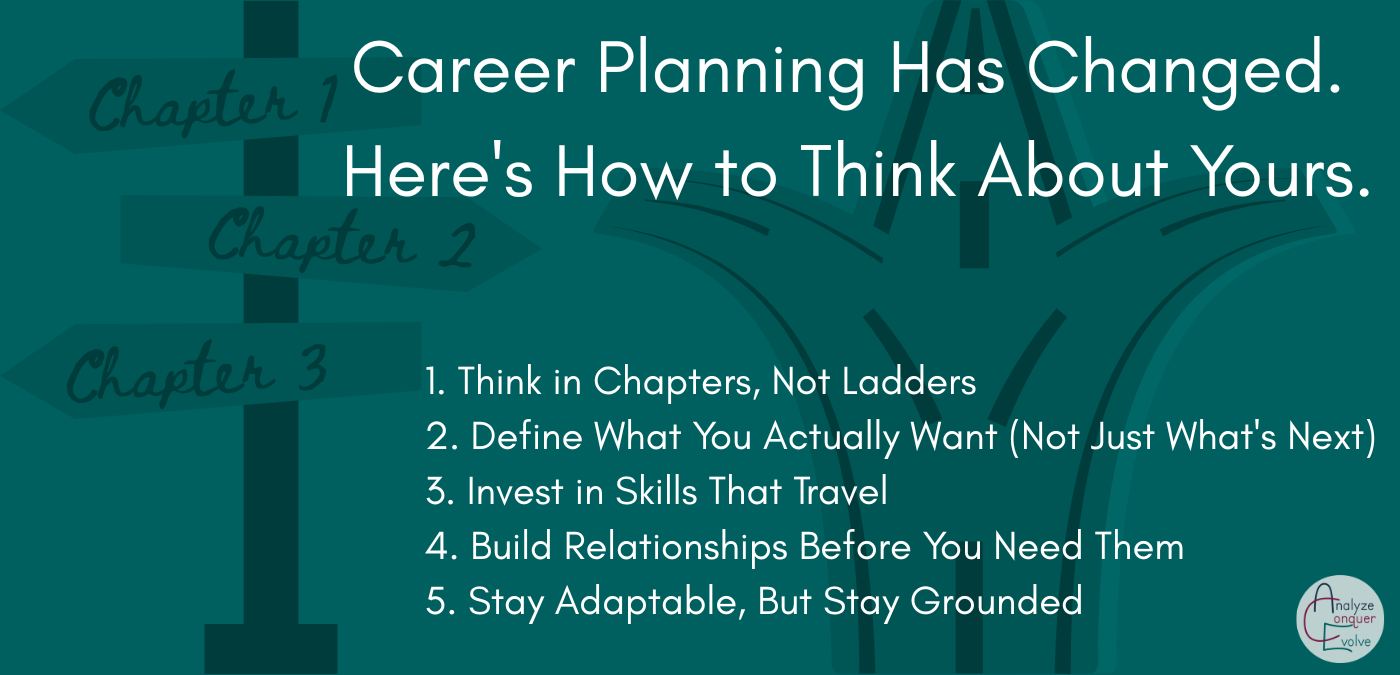
The 5 Pillars of Modern Career Planning
1. Think in Chapters, Not Ladders
The concept of a direct, uninterrupted ascent up a corporate ladder is obsolete. Real careers unfold as a series of deliberate chapters: phases that build on one another without necessarily heading in a single vertical direction.
Some chapters prioritize technical acquisition. Others focus on executive scope, recovery from burnout, or launching a new initiative. Some occur by design, and others happen due to external factors like restructuring.
When you adopt a chapter mindset:
- A lateral move shifts from an apparent setback into a strategic skill acquisition.
- Time spent mastering an adjacent technology represents an investment rather than a detour.
- A career transition or gap becomes an intentional narrative to explain rather than an apology to make.
2. Define What You Actually Want (Not Just What Comes Next)
A frequent mistake in career planning is optimizing for the immediate next promotion without assessing the target you are actually driving toward:
- What do you want your everyday routine and schedule to feel like?
- What types of operational problems give you genuine execution energy?
- What work environment allows you to produce your highest-quality output?
- What trade-offs are you willing to accept, and what boundaries are non-negotiable?
Without clear answers to these criteria, you are not steering your career: you are merely reacting to whatever opportunities appear in your inbox. Chasing external prestige often leads professionals into VP or Director seats only to realize they detest people management and miss system design. Clarify what matters to you first.
3. Invest in Skills That Travel
In a volatile market, your capabilities are your only true portable currency. However, not all capabilities carry equal weight.
Tool-specific skills tied to a single proprietary vendor or interface can depreciate rapidly. In contrast, portable capabilities travel across any stack or industry: distilling complex technical logic into plain language, leading cross-functional teams without formal authority, navigating ambiguous requirements, and interrogating data to make commercial decisions.
Ask yourself: if your organization switched platforms overnight or eliminated your department, what valuable assets would you carry out the door? Protect and cultivate those portable skills.
4. Build Relationships Long Before You Need Them
Networking carries a negative reputation because many professionals only engage when desperate for a job, reaching out cold to request referrals from loose acquaintances.
Effective networking is simply maintaining consistent, low-friction contact with former peers and mentors. It means offering thoughtful help without keeping score, sharing insights publicly, and building a professional reputation that encourages respected colleagues to advocate on your behalf.
In competitive hiring environments, warm referrals convert at exponentially higher rates than cold portal submissions. Do not wait for a layoff to start nurturing your network.
5. Stay Adaptable Without Chasing Trends
The market undeniably rewards professionals who evolve alongside technological shifts. Understanding generative AI workflows, for example, is rapidly becoming a baseline operational expectation rather than a niche specialty.
True adaptability, however, does not mean abandoning your path to chase every fleeting industry buzzword. It means maintaining a foundation so solid that integrating new tools feels like a natural extension of your workflow rather than an existential threat.
A Practical Framework to Start Today
If you want to move from high-level reflection to concrete execution, follow this straightforward roadmap:
- Conduct an Objective Career Audit: Evaluate your past 3 to 5 years. What initiatives generated energy? What drained your focus? Where did your capabilities expand most? Treat your trajectory like a dataset to audit without judgment.
- Isolate Your Exact Gaps: In relation to where you want to operate next, identify what is missing. Is it a demonstrable project in a cloud data stack? Executive presentation experience? Broader cross-functional visibility? Name the gap specifically.
- Draft a 12-Month Horizon (Not a 5-Year Plan): Long-range 5-year plans crumble because tech moves too quickly. A 12-month horizon provides enough time to achieve substantial milestones while remaining agile enough to pivot when circumstances shift.
- Anchor Your Goals Where You Review Them: A roadmap stored in a closed notebook is merely wishful thinking. Review your milestones monthly to verify whether your daily projects still align with your target direction.
Designing Your Career with Intent
Career navigation has not become simpler, but it has become significantly more personal. The era of passively trusting an employer to manage your growth is finished.
What replaces it is far more empowering: a career you design intentionally around your strengths, values, and lifestyle priorities. Unplanned disruptions will still happen, but when they do, you will not be caught off guard. You will know your worth, understand where you are heading, and possess the portable assets to pivot on your own terms.