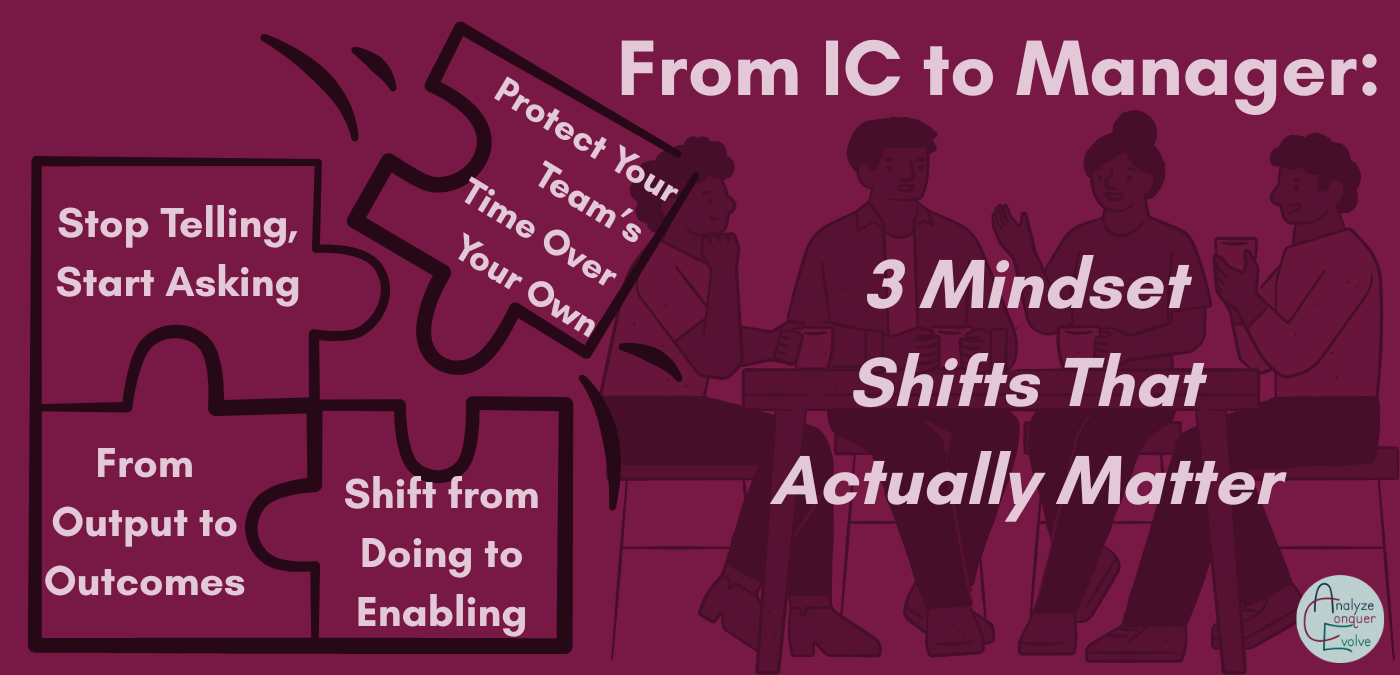
One of the most challenging transitions in my career was moving from an Individual Contributor (IC) to a Manager. I had been mentoring people for years before officially stepping into the role, and I had even completed formal leadership training. While both helped prepare me for the transition, I soon realized they were not enough on their own to turn me from a task manager into an effective leader.
Here are the three critical mindset shifts I have learned over the years that helped me move beyond simply directing work to actively leading the next generation of professionals.
1. Shift from Doing to Enabling
One of the first concepts I was taught in management was how to "get the monkeys off your back," which is shorthand for learning how to delegate. This is a vital lesson that most new leaders struggle with. When you have spent years being the person who writes the code, models the data, and delivers the work, stepping back from the front lines feels counterintuitive.
What leadership courses do not always teach you is how to not only delegate, but actively enable your team in the process. Many first-level managers stay hands-on with daily tasks because it feels safer. The real inflection point is learning how to be strategic about what you hand off.
Repetitive, comfortable tasks will not help you develop as an executive leader. Stepping into a strategic mindset will.
2. Stop Telling, Start Asking
There is a time and place for an autocratic, directive leadership style: keep that reserved for production emergencies and time-sensitive crises. In daily operations, telling your team exactly how to build every solution is a fast track to demotivating them and stunting their growth.
Instead, ensure your team understands the target outcome, then give them the latitude to engineer the solution. While seasoned seniors can run with high-level direction immediately, your junior practitioners will need thoughtful coaching. Ask them questions to understand their logic and approach before offering suggestions.
Take it a step further: ask them what downstream impacts their decisions might have compared to alternative paths. I often ask my senior technical leads the same thing. This also applies when team members bring you roadblocks. Encourage them to bring three possible solutions alongside the problem so you can evaluate options together.
3. Shift from Output to Outcomes
Measuring an engineering or data team solely by output (tickets closed, pull requests merged, or lines of code deployed) trains the team to optimize for the wrong targets. Instead, focus entirely on outcomes. Ensure your team provides the maximum measurable business value to the organization.
As an individual contributor, you were rewarded for speed and immediate execution. As a leader, you must orient toward the big picture. Even if your organization employs dedicated Project Managers, you remain accountable for ensuring your team tackles the right problems.
Involve your engineers and analysts in requirement gathering. When practitioners understand the underlying business rationale and how stakeholders consume the data, they become collaborative partners in the value chain rather than passive order-takers.
This also requires leading up and across. It is routine to work with department heads to prioritize tickets, but do you help them understand the broader scope of work your team manages for other departments? Does executive leadership recognize the commercial value your team delivers? Many technical teams lose headcount and budget simply because they are viewed as an expensive cost center. It is your job to translate technical architecture into clear business revenue and operational savings.
Bonus: Protect Your Team’s Time Over Your Own
I focus heavily on the value of dedicated focus time. As a manager, your team's focus comes first. Your daily priority is ensuring they can get the most out of their working hours:
- Encourage Focus Blocks: Help your team actively defend uninterrupted build time on their calendars.
- DEAD Days: Consider implementing a recurring "Drop Everything And Develop" day once a month or quarter with zero scheduled meetings.
- Monitor Meeting Fatigue: Track how many hours your engineers spend in meetings versus building solutions.
- Manage Intake Channels: Shield your team from unplanned side requests and rogue direct messages by funneling all work through an organized intake workflow.
Where Should You Begin?
This leadership evolution does not happen overnight, and it is not a fixed destination where you eventually stop learning. High-impact leadership requires a continuous commitment to growth.
The Analyze, Conquer, Evolve Approach to Leadership
- Analyze: What are your current strengths and blind spots as a leader? Solicit honest feedback from your manager, cross-functional peers, and your direct reports. Pick the single area that will make the biggest positive impact if improved, then break that goal into focused weekly actions.
- Conquer: Execute your plan. Treat your leadership development like an engineering initiative: set target dates, track your adjustments, and celebrate incremental wins with your team along the way.
- Evolve: Continuously refine your leadership roadmap. As your team expands and your organizational influence grows, your perspective will change. Re-evaluate regularly to identify new areas for optimization.
Leadership is a continuous path. It is completely natural to take detours or refine your objectives as long as you keep moving forward with purpose.